Introduction
Do you have questions about bladder prolapse, also called cystocele? Is it curable? Is it dangerous? What happens if you don't get treatment? Can it be treated with physical therapy? Will you need surgery? This article covers what you need to know.
Prevalence
Bladder prolapse is the most common of the three kinds of pelvic organ prolapse, and it's often seen alongside urinary incontinence in women 60 and older.
Anatomy
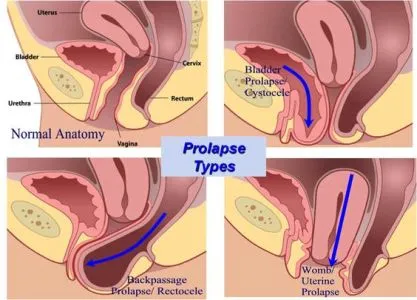
The pelvic floor has three main functions: supporting the bladder, the bowel, and sexual function. The organs associated with these functions, the bladder, rectum, and uterus, are supported by tissues called ligaments. Most of the time, these organs are held in place by a combination of strong ligaments and pelvic floor muscles. When the supportive ligaments and muscles weaken, the organs can begin to slide out of place and bulge through the vagina. With a bladder prolapse, the bladder begins to protrude through the front (anterior) vaginal wall.
The degree of bladder prolapse is measured by the extent of the prolapse relative to the hymen, and is classified as first, second, or third degree.
Symptoms of Bladder Prolapse
- Stress incontinence: urinary leakage with coughing, sneezing, or laughing
- Urge incontinence: a decreased ability to control and subside the urge to urinate
- Incomplete bladder emptying
- Recurrent urinary tract infections
- Difficulty inserting a tampon, or difficulty keeping one in during menstruation
- Difficulty initiating the urine stream
- A feeling of bladder fullness that increases toward the end of the day and improves when lying down
- A bulge that can be seen and felt at the vaginal opening, during straining or coughing while lying down, and in standing in more severe cases
- Pain and discomfort with intercourse
Causes and Risk Factors
- Childbirth, especially instrument-assisted vaginal delivery
- Constipation
- Chronic coughing, such as with COPD or other lung disease
- Repetitive heavy lifting and strenuous exercise, such as CrossFit
- Menopause: estrogen helps keep vaginal tissues supple, so after menopause the ligaments lose elasticity and become more prone to prolapse
- Any pelvic surgery
- Genetic factors
- Caucasian ethnicity
Diagnosis
Diagnosis includes a thorough history and physical exam to assess the degree of prolapse, along with testing such as urodynamics, to identify the type of incontinence, and a urine test to check for a UTI.
Treatment
Treatment depends on the degree of prolapse. No treatment may be needed if it isn't interfering with daily activities or causing urinary issues. Prolapse can remain asymptomatic until it reaches a certain point, so it isn't always recognized until it's advanced. In some women it progresses rapidly, and in others it remains stable for years. Research by Handa and colleagues (2004) found spontaneous regression in cases of mild prolapse, and Miedel and colleagues (2011) found that only a small percentage of women with prolapse worsened over five years. Bladder prolapse isn't dangerous in mild cases: it's mainly an inconvenience, and most less severe cases can be treated effectively with a combination of lifestyle changes, pelvic floor therapy, and medication. Severe prolapse may require surgery.
Lifestyle Changes
- Weight loss, if overweight
- Treating chronic cough
- Avoiding straining and managing constipation
- Pelvic floor muscle exercises (Kegels)
- A pessary, which may take some practice to insert and requires regular follow-up with your doctor
Pelvic Floor Exercises
Pelvic floor muscle training (PFMT) has been found to have a positive effect on pelvic organ prolapse, for a couple of hypothesized reasons (Bo, 2004):
- Women learn to contract the pelvic floor before and during any increase in intra-abdominal pressure, such as when lifting something heavy
- Regular strengthening exercises build the strength of the pelvic floor and its structural support over time
The Knack
"The Knack" is a technique pelvic physical therapists teach: consciously contracting the pelvic floor muscles before an activity that increases intra-abdominal pressure, such as lifting something heavy, or before a cough or sneeze, if you can predict it. I instruct my patients to "squeeze before you sneeze." It takes some practice, but patients typically report it becomes effective after about three to four weeks of regular pelvic floor exercises.
Medications
Estrogen replacement therapy may be used as part of treatment.
Surgery
Surgical options are usually considered for severe degrees of prolapse, or when conservative management hasn't been effective. Prolapse recurs in about 70% of women who have surgery (Iglesia et al., 2010), and about a third of operated women undergo a further surgical procedure for prolapse (Olsen et al., 1997).
Types of surgery include:
- Reconstructive surgery, which restores the organs to their original position. Normal activities can typically resume after recovery.
- Obliterative surgery, which narrows and closes off the vagina to support the prolapse. Sexual intercourse isn't possible after this surgery.
These procedures can be done as open surgery, laparoscopic surgery, or robotic-assisted surgery. Recovery time depends on the type of surgery, but doctors usually recommend avoiding heavy lifting, straining, and sexual activity for six weeks after surgery.
Conclusion
- Bladder prolapse is a treatable condition, and patients can return to a good quality of life after diagnosis
- Mild degrees of prolapse can be treated effectively, most of the time, with physical therapy, a pessary, and lifestyle modification
- Surgery is an option for advanced prolapse
Bladder prolapse is closely linked to pelvic organ prolapse and urinary incontinence. Learn more about our approach to pelvic organ prolapse and incontinence, or request an appointment to talk with Dr. Kavitha directly.