Introduction
Uterine prolapse is a common condition in women. Statistically, nearly half of women between ages 50 and 79 have some degree of it. It isn't medically dangerous or an emergency condition, and people can continue to engage in sexual activity after a diagnosis of prolapse, though intercourse may feel uncomfortable.
Anatomy
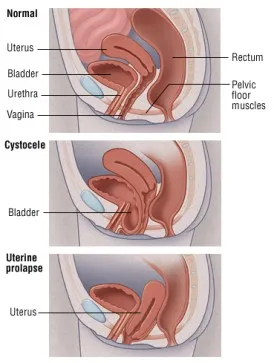
The uterus sits in the pelvis, supported by ligaments and pelvic floor muscles that form a kind of hammock. When the pelvic floor muscles and ligaments weaken, the organs are no longer held in place and may sag or drop out of position through the vagina.
Causes
Damage to the structures that support the uterus can occur due to:
- Childbirth, usually the most significant cause
- Chronic constipation
- Chronic coughing
- Genetically weak connective tissue
- The aging process
Diagnosis and Degree of Prolapse
The degree of prolapse depends on how far down the vagina the uterus has descended. Your doctor will determine the degree of prolapse during a pelvic exam. If you have symptoms of incomplete bladder emptying, your doctor may perform a cystoscopy to look inside the bladder. An MRI may also be used to more accurately assess the internal organs.
Uterine Prolapse and Infertility
Uterine prolapse can reduce the chance of conceiving, since the uterus isn't positioned properly to receive and keep sperm alive (sperm dies when exposed to air). This can be corrected surgically with a procedure called hysteropexy.
Uterine Prolapse and Pregnancy
Women with mild to moderate prolapse can still become pregnant. During pregnancy, the progression of prolapse can be minimized with lifestyle modifications. Learning to relax the pelvic floor, through diaphragmatic breathing, is important for a smooth vaginal birth and to avoid further increasing the prolapse. It's recommended to discuss the type of birth, vaginal versus C-section, with your doctor, keeping the prolapse in mind.
Uterine Prolapse and Running
Running is a high-impact activity that puts significant strain on the pelvic floor, and uterine prolapse has the potential to worsen with running. Things that can help prevent the prolapse from getting worse include:
- Decreasing the speed of running
- Decreasing the running distance, since long-distance running puts prolonged pressure on the pelvic floor
- Running on a level surface and avoiding concrete
- Avoiding running uphill, since the forward-leaning posture used going uphill can increase intra-abdominal pressure and affect the pelvic floor
Symptoms Specific to Uterine Prolapse
It's time to see a doctor when you experience these symptoms:
- Heaviness, pulling, or pain in the vagina. Patients often describe this as "I feel like something is falling out of my vagina."
- Progressively increasing heaviness in the vagina as the day goes on. In advanced cases, a pink bulge can be noticed at the vaginal entrance, in standing or with coughing and straining
- Pain with sexual intercourse
- Urine leakage during sex
- Difficulty or inability to have an orgasm
- Stress urinary incontinence (leakage with coughing, sneezing, or laughing)
- Difficulty with bowel movements
- Needing to use a finger through the vagina to help empty the bladder or have a bowel movement
Treatment: Lifestyle Modifications
Controlling what you're able to control can help manage symptoms:
- Use proper biomechanics when lifting, pushing, or pulling: don't hold your breath, exhale with exertion, and lift from your legs rather than your back
- Watch your sitting posture. Avoid slouching on the couch or at your desk, to decrease pressure on the pelvic floor
- Watch your standing posture. Try to maintain a neutral spine, since slouching prevents the core muscles from firing effectively, and the pelvic floor and core need to work together
- Manage your weight
Most prolapses, once symptomatic, need some degree of intervention. Mild to moderate degrees of prolapse can be treated, and in some cases reversed, with physical therapy and Kegel exercises, which can adequately strengthen the muscles to prevent further progression. Severe degrees of prolapse still benefit from skilled physical therapy as a preoperative step to strengthen the muscles: going into surgery stronger generally means a faster recovery. Once prolapse reaches a severe degree, it will typically need surgery, since it will continue to worsen otherwise.
Surgical Repair: Vaginal Hysterectomy
A vaginal hysterectomy is the most common surgery used to address uterine prolapse. In this procedure, the uterus is removed through the vagina, which allows for a better recovery with no abdominal or laparoscopic incisions. The surgery is performed in a hospital setting under general or spinal anesthesia. The surgeon makes an incision around the cervix, carefully moves the bladder and rectum aside, clamps the major blood vessels, removes the uterus, and sutures the top of the vagina, which is called the vaginal vault.
Success Rate After Surgery
About 85% of women who have a vaginal hysterectomy are cured of uterine prolapse. About 15% may develop a vaginal vault prolapse in the months or years afterward.
Complications of Surgery
As with any surgery, there are some possible complications:
- Infection, whether at the surgical site or a urinary tract infection
- Blood clots
- Urinary retention
- Injury to adjacent organs during surgery
Recovery After Surgery
Patients are usually recommended to take it easy for about six weeks and avoid heavy lifting. Sexual activity may be resumed after six weeks, following discussion with your doctor.
Conclusion
- Treatment of uterine prolapse depends on the degree of prolapse
- Pelvic physical therapy and lifestyle modification are effective ways to manage mild to moderate prolapse
- Surgery is an option for advanced stages of prolapse
Uterine prolapse is a form of pelvic organ prolapse that's closely tied to childbirth. Learn more about our approach to pelvic organ prolapse and postpartum recovery, or request an appointment to talk with Dr. Kavitha directly.